
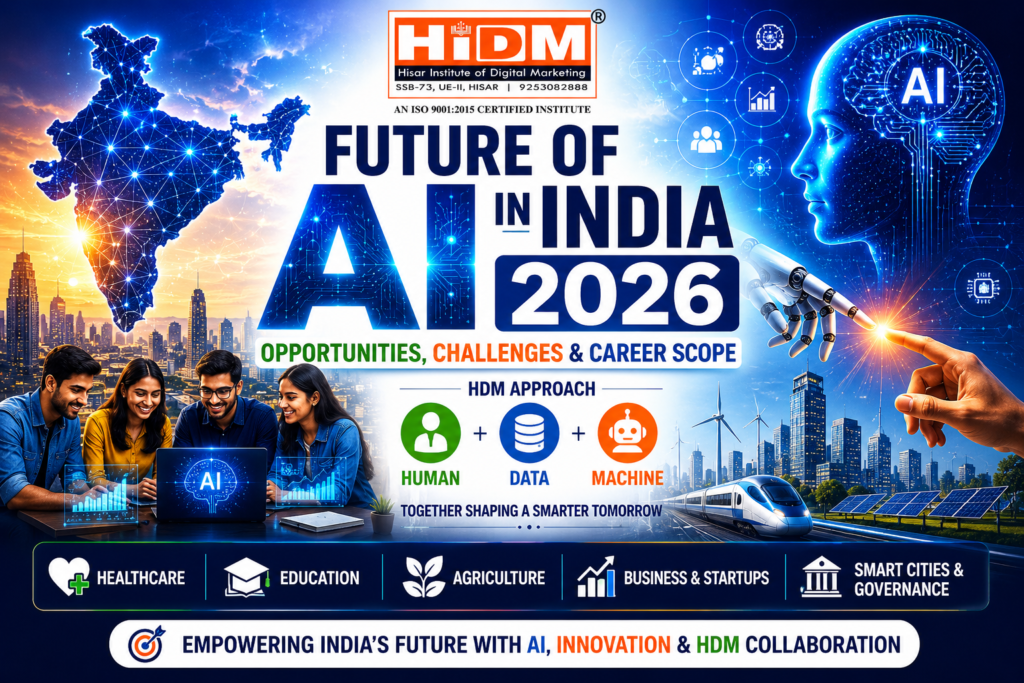
The future of AI in India 2026 is one of the most exciting and transformative topics in today’s digital era. As technology continues to evolve rapidly, artificial intelligence (AI) is becoming a key driver of growth across multiple industries. In India, especially, AI adoption is increasing at a significant pace. Therefore, businesses, startups, and even government sectors are investing heavily in AI-powered solutions.
Moreover, the concept of HDM (Human + Data + Machine) is becoming highly relevant in this transformation. While machines (AI) process data at scale, human intelligence ensures better judgment and ethical decision-making. As a result, a balanced combination of humans, data, and machines is shaping the future of AI in India.
Additionally, institutes like HiDM (Hisar Institute of Digital Marketing) are playing an important role in this transformation. HiDM provides practical training in digital marketing along with AI tools and automation. Therefore, students not only learn theory but also understand how AI works in real-world scenarios.
On the other hand, this rapid growth also brings several challenges that need to be addressed carefully. Thus, understanding the opportunities, challenges, and career scope of AI in India is crucial for students, professionals, and entrepreneurs alike.
What is Artificial Intelligence and Why It Matters in India?
Artificial Intelligence refers to the simulation of human intelligence in machines that are programmed to think, learn, and make decisions. In simple terms, AI enables computers to perform tasks that usually require human intelligence.
However, AI alone is not enough. The integration of HDM (Human + Data + Machine) makes AI systems more effective. While machines analyze large datasets, humans interpret results and make strategic decisions.
In India, AI matters more than ever. Firstly, the country has a massive population and data ecosystem, which provides a strong foundation for AI development. Secondly, India is witnessing rapid digital transformation across sectors like healthcare, education, finance, and agriculture. As a result, AI combined with human decision-making is becoming essential for improving efficiency and productivity.
Furthermore, practical learning platforms such as HiDM (Hisar Institute of Digital Marketing) are helping students understand how AI tools like ChatGPT, automation software, and analytics platforms work in real industries. Therefore, AI is not just a trend but a skill-based revolution in India.
Growth of AI in India: Current Scenario
Currently, India is among the fastest-growing AI markets in the world. According to industry reports, AI adoption has increased significantly in the last few years. Many startups and tech companies are developing AI-based solutions to solve real-world problems.
For instance, AI is being used in chatbots, recommendation systems, fraud detection, and healthcare diagnostics. Additionally, major IT companies are integrating AI into their services to stay competitive in the global market.
At the same time, HDM plays a crucial role in this growth. While AI systems generate insights, human experts validate and apply those insights effectively. Therefore, the collaboration between humans and machines is driving innovation.
Moreover, training institutes like HiDM are reducing the skill gap by offering AI-integrated digital marketing courses, where students work on live projects. As a result, learners gain hands-on experience which is highly valuable in today’s job market.
However, there is still a gap in advanced AI talent, which needs to be addressed in the coming years
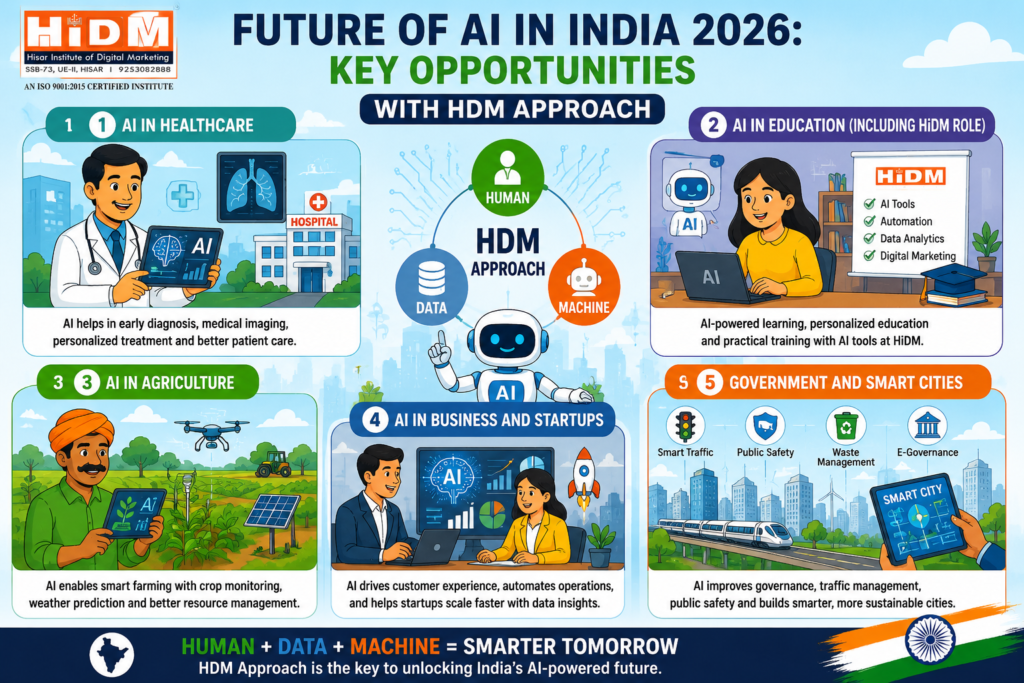
Future of AI in India 2026: Key Opportunities with HDM Approach
1. AI in Healthcare
One of the biggest opportunities in the future of AI in India 2026 lies in healthcare. AI can help in early disease detection, medical imaging, and personalized treatment.
However, with the HDM approach, doctors (humans) work alongside AI tools (machines) using patient data. As a result, decision-making becomes faster, more accurate, and more reliable.
2. AI in Education (Including HiDM Role)
Similarly, AI is transforming the education sector. AI-based platforms can provide personalized learning experiences to students.
At the same time, institutes like HiDM (Hisar Institute of Digital Marketing) are integrating AI into their courses. Students learn tools like AI content generators, automation software, and data analytics platforms.
Therefore, the HDM model ensures better learning outcomes. Consequently, students benefit from both technology and human guidance
3. AI in Agriculture
Agriculture is another sector where AI can create a huge impact. Farmers can use AI tools to predict weather conditions, monitor crop health, and optimize irrigation.
However, farmers’ experience and decision-making are equally important. Thus, combining human knowledge with machine intelligence leads to better results.
4. AI in Business and Startups
India’s startup ecosystem is rapidly adopting AI technologies. From e-commerce to fintech, AI is being used to enhance customer experience and improve operations.
Moreover, business leaders use data insights generated by AI to make strategic decisions. Therefore, the HDM model helps startups grow faster and scale efficiently.
Additionally, students trained at institutes like HiDM are becoming job-ready for such AI-driven roles.
5. Government and Smart Cities
The government is also leveraging AI for smart city development, traffic management, and public safety.
For instance, AI-based systems analyze large datasets, while policymakers make final decisions based on those insights. Thus, HDM ensures better governance and transparency.
Challenges in the Future of AI in India 2026
While there are many opportunities, the future of AI in India 2026 also comes with several challenges.
1. Lack of Skilled Workforce
Firstly, there is a shortage of skilled AI professionals in India. Therefore, institutions like HiDM are important because they provide practical, industry-based training.
2. Data Privacy and Security Issues
Secondly, AI relies heavily on data. However, data privacy and security are major concerns. Thus, human oversight is necessary.
3. High Implementation Costs
Implementing AI solutions can be expensive. However, trained professionals can optimize resources effectively.
4. Ethical Concerns
AI also raises ethical questions related to bias and transparency. Therefore, human involvement is crucial.
5. Job Displacement vs Job Transformation
While AI may replace some jobs, it also creates new opportunities. Hence, institutes like HiDM are helping students upskill for future-ready careers.
Career Scope in AI with HDM in India 2026
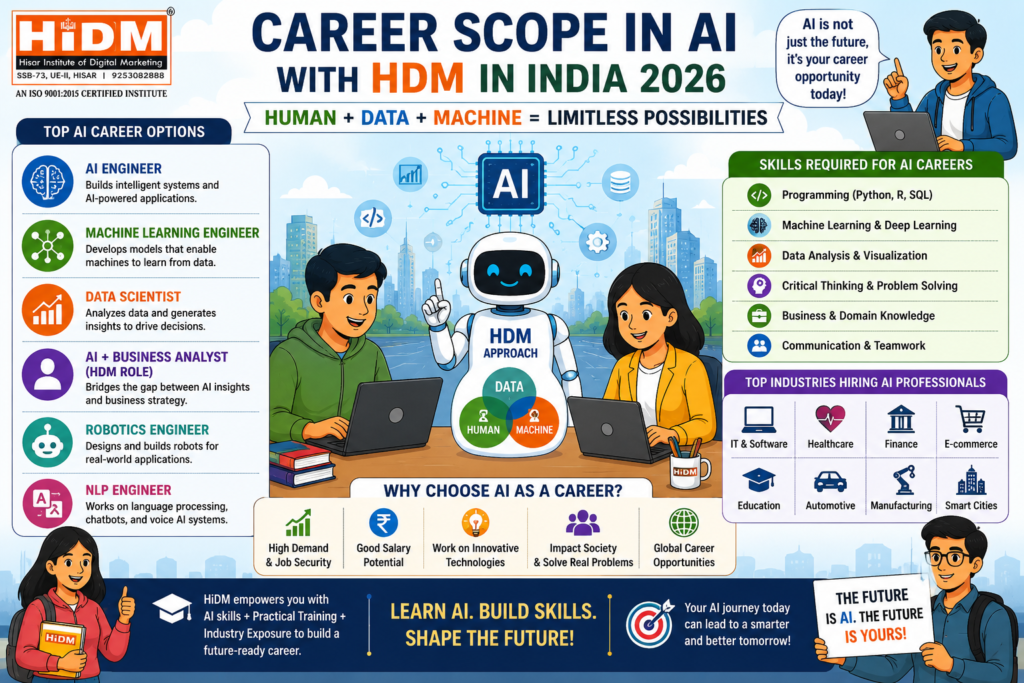
The career scope in AI is extremely promising. However, future professionals must understand both AI technologies and human decision-making processes.
Top AI Career Options
- AI Engineer
- Machine Learning Engineer
- Data Scientist
- AI + Business Analyst (HDM role)
- Robotics Engineer
- NLP Engineer
Skills Required for AI Careers
To succeed in AI and HDM roles, one needs:
- Programming skills (Python, R)
- Machine learning knowledge
- Data analysis skills
- Critical thinking and decision-making
- Business understanding
Additionally, practical exposure from institutes like HiDM (Hisar Institute of Digital Marketing) helps students gain real-world experience
Conclusion
In conclusion, the future of AI in India 2026 is full of opportunities and challenges. On one hand, AI has the potential to revolutionize industries and create new career opportunities. On the other hand, challenges like data privacy and skill gaps remain.
However, the integration of HDM (Human + Data + Machine) provides a balanced approach. Moreover, institutes like HiDM are preparing students for this AI-driven future by offering practical training and industry exposure.
Therefore, by combining human intelligence with machine efficiency, India can become a global leader in AI.