
Seminar Indroduction

The Evolution of Market Research in the AI Era
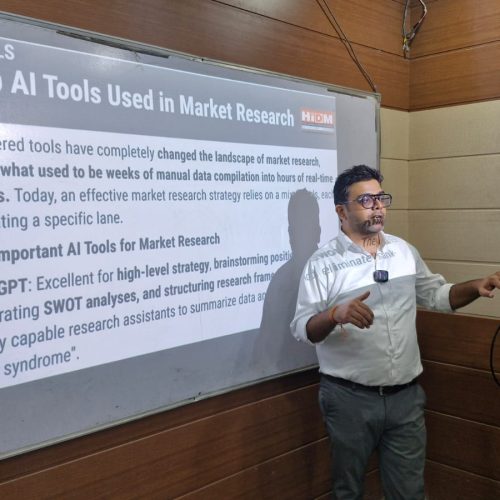
The seminar The Evolution of Market Research in the AI Era explored how Artificial Intelligence is transforming traditional market research methods into faster, smarter, and more data-driven processes. Presented by Ishaan, an HIDM student passionate about Artificial Intelligence and Digital Marketing, the session highlighted the role of AI in consumer behavior analysis, SEO tools, predictive analytics, and real-time market insights.
The Evolution of Market Research in the AI Era also emphasized the future trends, opportunities, and challenges of AI-powered research, helping businesses make informed decisions and stay competitive in the digital world.
What Is Market Research?
Market research is the systematic process of gathering, recording, and analyzing data and information about a specific market, including information about the target audience, competitors, and the overall industry. It is a structured approach that businesses use to understand what customers want, what competitors are doing, and what trends are shaping the marketplace.
In simple terms, market research is the art and science of asking the right questions to the right people at the right time. Think of it as a detective’s job for a business — before launching a product, entering a new market, or making a strategic decision, a company first investigates: Who are my customers? What do they want? How much will they pay? Who are my competitors?
Furthermore, market research involves two major types of data:
Primary Data: Firstly, this data is collected firsthand directly from respondents through surveys, interviews, focus groups, and observation. For example, a company launching a new energy drink may conduct taste tests and surveys with college students.
Secondary Data: In addition, this data is already available from published sources such as government reports, industry publications, company reports, and research journals. For instance, businesses may use IBEF (India Brand Equity Foundation) data to understand the FMCG sector.
Moreover, without market research, businesses often make decisions based on guesses rather than facts. Therefore, it serves as the foundation of every successful product launch, marketing campaign, and business strategy. According to a 2023 report by Statista, companies that invest in regular market research are 2.5 times more likely to exceed their revenue targets compared to those that do not.
About the Speaker
Ishaan is a dedicated student at HIDM (Hisar Institute of Digital Marketing) with a strong passion for Artificial Intelligence and Digital Marketing. He is enthusiastic about exploring how modern technologies are transforming businesses and shaping the future of marketing.
In this seminar, Ishaan will present on the topic “The Evolution of Market Research in the AI Era,” where he will discuss how Artificial Intelligence is revolutionizing traditional market research methods, enhancing consumer behavior analysis, and helping businesses make smarter, data-driven decisions.
What You'll learn
- HISTORY AND EVOLUTION OF MARKET RESEARCH
- UNDERSTANDING AI
- Role Of AI In Market Research
- Modern Tools and Technologies
- Advantages Of AI In Market Research
- Challenges & Limitation Of AI In Market Research
- Case Studies And Real-World Application
- Future Of Market Research
- CONCLUSION
Seminar Gallery



1. HISTORY AND EVOLUTION OF MARKET RESEARCH
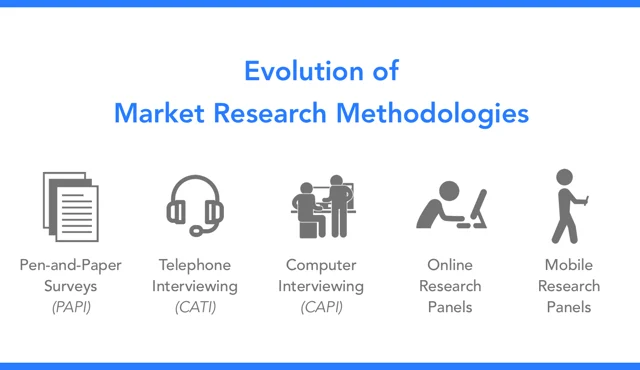
The history of formal market research dates back to the 1920s in the United States. In 1923, Daniel Starch began measuring advertisement readership, and later, in 1933, A.C. Nielsen began retail store audits. Consequently, these early pioneers laid the foundation for the modern market research industry.
Over time, several traditional market research methods became widely popular. The major traditional market research methods included:
Face-to-Face Surveys: Initially, researchers would stand in markets, malls, or neighborhoods with printed questionnaires and interview respondents personally. Although this method was time-consuming, it provided detailed qualitative insights.
Telephone Surveys: Subsequently, by the 1960s and 1970s, telephone surveys became popular. Companies would call households and ask structured questions. As a result, this allowed for faster data collection than door-to-door surveys.
Focus Groups: Furthermore, groups of 8–12 people were brought together in a conference room. A moderator asked open-ended questions about a product, service, or concept. Consequently, these sessions provided rich qualitative insights into consumer opinions and emotions.
Observation Research: In addition, researchers would physically observe consumer behavior in stores, recording how shoppers moved through aisles, which products they picked up, and how long they spent at each display.
Mail Surveys: Similarly, questionnaires were sent by post to target audiences. However, response rates were typically very low (5–15%), and the process was extremely slow, sometimes taking months.
Mystery Shopping: Finally, trained researchers visited stores as regular customers to evaluate service quality, staff behavior, product availability, and overall customer experience.
2. UNDERSTANDING AI
The concept of AI was formally introduced by British mathematician Alan Turing in 1950, when he proposed the famous ‘Turing Test’ — a machine could be considered intelligent if it could converse with a human without the human knowing they were talking to a machine. The term ‘Artificial Intelligence’ itself was coined by John McCarthy in 1956 at the Dartmouth Conference.
Key concepts in AI include:
- Natural Language Processing (NLP): Enables machines to understand, interpret, and generate human language. NLP powers applications like Google Translate, Siri, Alexa, and chatbots. For example, when you type a query on Google, NLP algorithms understand the intent behind your words.
- Computer Vision: Enables machines to interpret and understand visual information from the world — images, videos, and live camera feeds. Used in facial recognition (Aadhaar biometric authentication), quality control in manufacturing, and self-driving vehicles.
- Expert Systems: AI programs that emulate the decision-making ability of a human expert. Used in medical diagnosis systems (IBM Watson Health diagnoses certain cancers with 96% accuracy vs. 50% by human doctors).
- Robotics: Combining AI with mechanical systems to create intelligent robots. Used in automated warehouses like Amazon’s fulfillment centers where robots pick and pack orders.

3. Role Of AI In Market Research
Artificial Intelligence (AI) plays a major role in modern market research by helping businesses collect, analyze, and interpret large amounts of data quickly and accurately. As a result, it enables companies to understand customer behavior, predict trends, and make better business decisions.
Key Roles of AI in Market Research
Data Collection: Firstly, AI gathers data from websites, social media, surveys, customer reviews, and online platforms automatically. Consequently, businesses can collect large volumes of data in less time.
Consumer Behavior Analysis: Moreover, AI studies customer preferences, buying patterns, and online activities to understand what consumers want. Therefore, companies can create more targeted marketing strategies.
Predictive Analytics: In addition, AI predicts future market trends and customer demands by analyzing past and present data. As a result, businesses can prepare for upcoming opportunities and challenges.
Sentiment Analysis: Furthermore, AI identifies whether customer opinions and reviews are positive, negative, or neutral. This helps companies understand public perception of their products and services.
Competitor Analysis: Similarly, AI monitors competitors’ strategies, pricing, products, and customer feedback. Consequently, businesses can stay competitive in the market.
Survey Automation: Additionally, AI creates, distributes, and analyzes surveys faster than traditional methods. Thus, the research process becomes more efficient.
Real-Time Insights: Most importantly, AI provides instant market insights, helping businesses respond quickly to changing conditions and consumer demands.
Personalization: Finally, AI helps companies design products, services, and marketing campaigns tailored to specific customer groups, thereby improving customer satisfaction and engagement.
4. Modern Tools and Technologies
Modern tools and technologies have transformed market research from a manual and time-consuming process into a fast, accurate, and data-driven activity. These tools help businesses collect, analyze, and interpret customer data more efficiently, enabling them to make smarter decisions.
Key modern tools and technologies
AI-powered analytics tools: Tools like ChatGPT, Google Analytics, and predictive analytics platforms help businesses analyze large datasets and generate valuable insights.
Online survey platforms: Tools such as SurveyMonkey and Google Forms make it easy to create, distribute, and analyze surveys quickly.
Social media listening tools: Platforms like Brandwatch and Hootsuite monitor customer conversations, opinions, and trends on social media.
Big data analytics: Big data tools process massive amounts of structured and unstructured data to identify patterns and market trends.
Web scraping tools: These tools automatically collect data from websites, competitor platforms, and online marketplaces for research purposes.
Customer relationship management (CRM) systems: CRM tools like Salesforce help businesses manage customer interactions and understand customer preferences.
Data visualization tools: Tools such as Tableau and Power BI present complex data in easy-to-understand charts, graphs, and dashboards.
Mobile research applications: Mobile apps allow researchers to collect real-time feedback and conduct surveys directly from consumers.

5. Advantages Of AI In Market Research
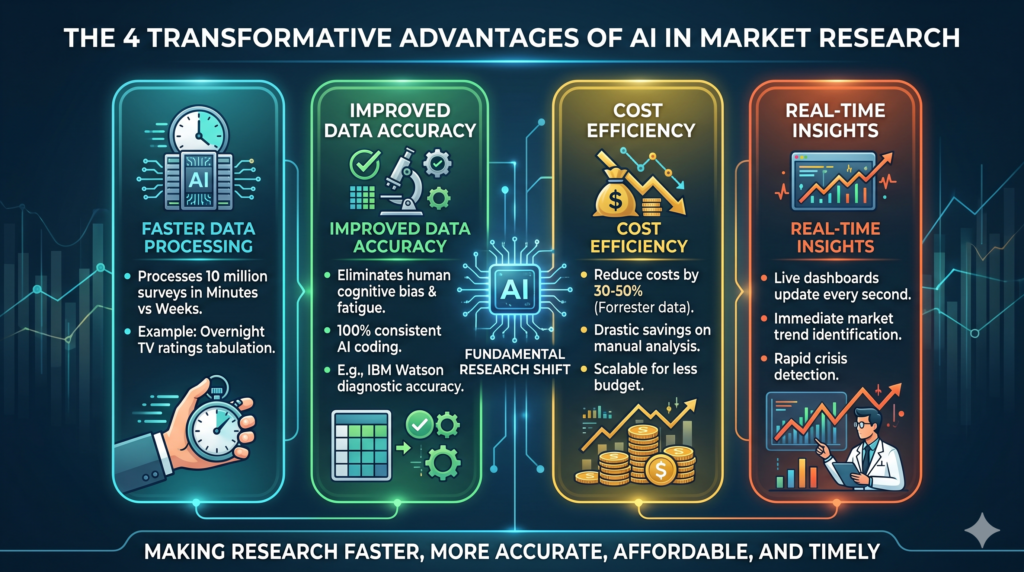
Artificial Intelligence (AI) offers many advantages in market research by making the process faster, smarter, and more efficient. As a result, it helps businesses understand their customers better and make data-driven decisions.
Key Advantages of AI in Market Research
Faster Data Analysis: Firstly, AI can process large amounts of data in seconds, thereby saving significant time compared to manual analysis.
Improved Accuracy: Moreover, AI reduces human errors and provides more precise research results. Consequently, businesses can rely on more accurate insights.
Real-Time Insights: In addition, businesses can get instant updates about customer behavior and market trends. Therefore, they can respond quickly to changing market conditions.
Better Consumer Understanding: Furthermore, AI analyzes customer preferences, buying habits, and feedback to understand consumer needs. As a result, companies can improve their products and services.
Cost-Effective: Similarly, AI automates many research tasks, thereby reducing the overall cost of market research.
Predictive Analytics: Additionally, AI can forecast future trends and customer demands based on past data. Thus, businesses can prepare better strategies for the future.
Personalized Marketing: Most importantly, AI helps create targeted marketing campaigns for specific customer groups, which increases customer engagement.
Competitive Advantage: Finally, companies can monitor competitors and respond quickly to market changes. Consequently, they gain a stronger position in the competitive market.
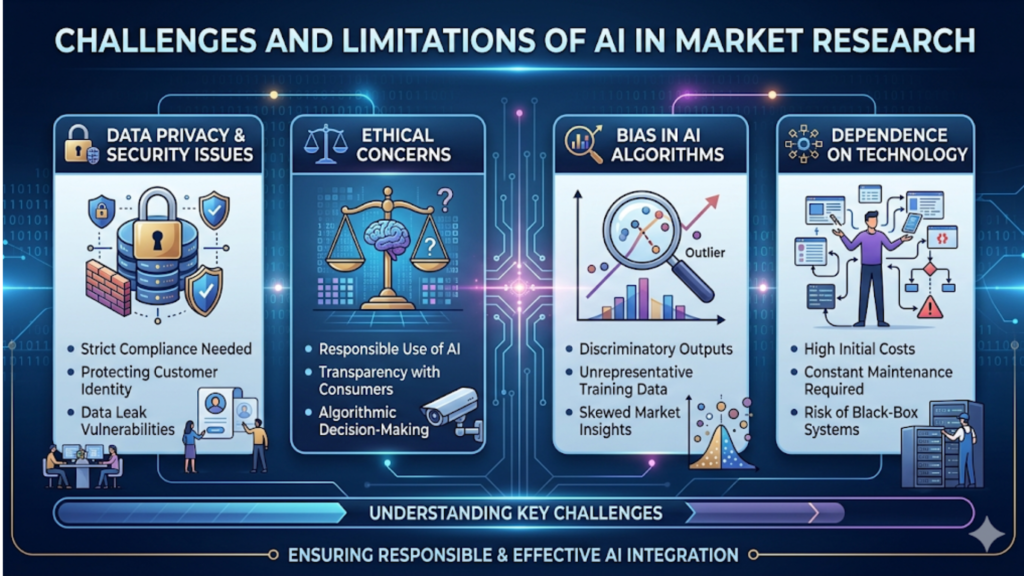
6. Challenges & Limitation Of AI In Market Research
Artificial Intelligence (AI) has transformed market research, but it also has several challenges and limitations. Businesses must understand these issues to use AI effectively and responsibly.
Key challenges and limitations
Data privacy concerns: AI collects and analyzes large amounts of customer data, which may raise privacy and security issues if not handled properly.
High implementation cost: Advanced AI tools and technologies can be expensive for small businesses to adopt and maintain.
Dependence on quality data: AI results are only as good as the data provided. Poor or incomplete data can lead to inaccurate insights.
Lack of human judgment: AI can analyze data, but it may not fully understand human emotions, cultural differences, or complex consumer behavior.
Bias in AI algorithms: If the training data is biased, AI may produce unfair or misleading research results.
Technical complexity: Using AI tools often requires skilled professionals who understand data analysis, machine learning, and technology.
Over-reliance on automation: Excessive dependence on AI may reduce critical thinking and human creativity in research.
Limited understanding of context: AI may misinterpret sarcasm, humor, or regional language nuances in customer feedback.
7. Case Studies And Real-World Application


TWO LANDMARK CASE STUDIES
- Amazon — AI in E-commerce Research
35% revenue from AI recommendations
- Recommendation Engine: Amazon’s collaborative filtering algorithm analyzes individual purchase history, browsing behavior, wish lists, and similar customers’ behavior to generate personalized product recommendations. This single AI system accounts for 35% of Amazon’s total revenue — making it the most commercially successful market research application in history.
- Dynamic Pricing: Amazon’s algorithms change prices approximately 2.5 million times per day based on competitor prices, demand patterns, inventory levels, and individual customer price sensitivity. This represents real-time competitive market research applied directly to pricing strategy.
- Product Development Research: Amazon uses behavioral data from its marketplace to identify gaps — product categories with high search volume but insufficient supply or quality. This insight has driven the development of hundreds of Amazon private label products (Amazon Basics, Amazon Essentials).
- Market Entry Decisions: Before entering new service categories (Amazon Fresh groceries, Amazon Pharmacy), the company uses data from its existing customer base to validate demand and identify the most promising geographic markets.
2. Procter & Gamble – AI in Consumer Goods Industry
30% faster product development
- Consumer Intelligence Platform: P&G built a proprietary Consumer Pulse system that continuously monitors social media, news, and review platforms in 180 countries in 30 languages. NLP algorithms analyze sentiment, identify emerging concerns, and detect trend inflection points — providing global brand health data in real time.
- Product Innovation Research: P&G’s AI analyzes consumer feedback from multiple touchpoints to identify unmet needs. For example, analysis of millions of diaper reviews, parenting forums, and pediatrician recommendations led to the development of new Pampers features addressing specific pain points identified through AI analysis.
- Marketing Optimization: P&G uses AI to analyze which creative elements in advertisements drive the most positive consumer response. Their ‘Marketing Return Calculator’ AI model has enabled P&G to optimize marketing spending, reportedly saving USD 750 million annually in marketing costs.
- Supply Chain Research: AI predicts consumer demand changes (seasonal, trend-driven, emergency-driven) enabling P&G to adjust manufacturing and distribution proactively.
8. Future Of Market Research
The future of market research will be driven by Artificial Intelligence (AI), big data, automation, and real-time analytics. Traditional research methods are evolving into faster, smarter, and more personalized approaches that help businesses understand customers better and make data-driven decisions.
Key trends shaping the future
AI-powered research: AI will automate data collection, analysis, and reporting, making research faster and more accurate.
Real-time insights: Businesses will receive instant updates about customer behavior, market trends, and competitor activities.
Predictive analytics: AI will help forecast future consumer demands, buying patterns, and market opportunities.
Personalized research: Companies will gather more targeted insights from specific customer groups instead of using one-size-fits-all surveys.
Voice and visual analytics: Future research will analyze voice searches, video content, and images to understand consumer preferences.
Social media intelligence: AI will monitor social media conversations to identify trends, opinions, and customer sentiment.
Ethical and privacy-focused research: Data protection and transparency will become more important as businesses collect more customer information.
Human-AI collaboration: AI will assist researchers, but human creativity and judgment will still be essential for interpreting complex consumer behavior.

Conclusion
In conclusion, the evolution of market research in the AI era has transformed the way businesses collect, analyze, and interpret data. Artificial Intelligence has made market research faster, more accurate, and more efficient by providing real-time insights, predictive analytics, and a better understanding of consumer behavior.
Modern tools and technologies have enabled companies to make smarter, data-driven decisions while reducing time and costs. However, AI also brings challenges such as data privacy, ethical concerns, and algorithmic bias, which must be addressed responsibly.
Therefore, the future of market research lies in the collaboration between AI and human intelligence. AI will not replace market researchers; instead, it will empower them with advanced tools and deeper insights to create more effective marketing strategies and achieve business growth.