
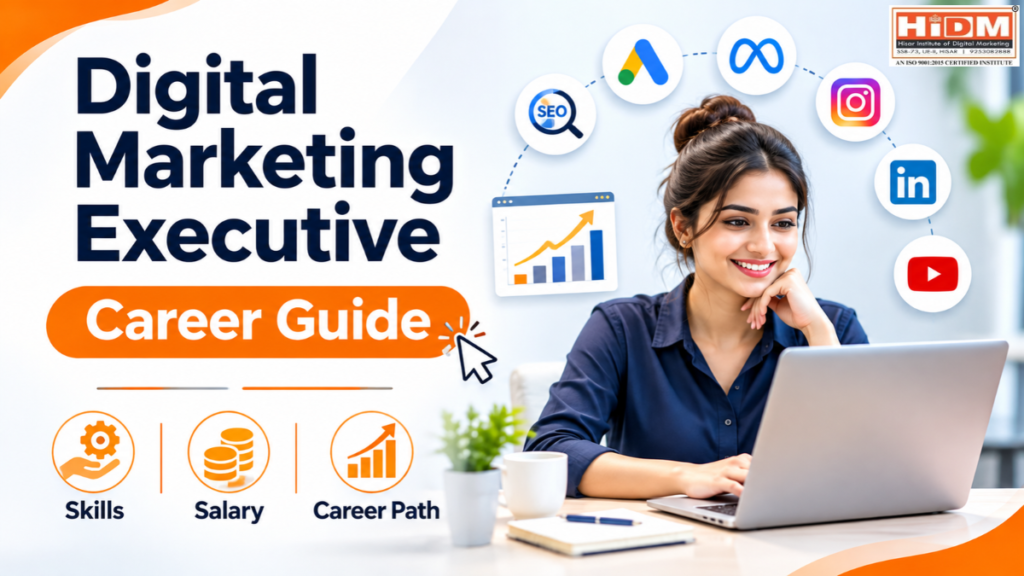
Digital marketing has become an essential part of modern business. From small local businesses to large companies, brands use digital channels to reach customers, generate leads, build awareness, and increase sales.
This growing dependence on digital platforms has created career opportunities for people with skills in SEO, social media marketing, paid advertising, content marketing, analytics, email marketing, and AI-powered marketing.
One of the most common entry-level roles in this industry is Digital Marketing Executive.
If you are a student, fresher, graduate, or someone planning a career change, this role can give you exposure to multiple areas of digital marketing and help you decide which specialization you want to pursue.
In this guide, you will learn what a Digital Marketing Executive does, which skills are required, what tools to learn, how much you can potentially earn, how the career path works, and how to prepare for your first digital marketing job in 2026.
What Is a Digital Marketing Executive?
A Digital Marketing Executive is a professional who helps a company or brand promote its products and services through digital channels.
The exact responsibilities can vary depending on the organization. In a digital marketing agency, an executive may work with multiple clients, while an in-house executive may focus on the marketing activities of one company.
A Digital Marketing Executive may work on:
- Search Engine Optimization (SEO)
- Social media marketing
- Google Ads
- Meta Ads
- Content marketing
- Email marketing
- Website optimization
- Lead generation
- Analytics and reporting
- Online reputation
- AI-assisted marketing activities
For a fresher, this role can be particularly useful because it provides exposure to different areas of digital marketing.
What Does a Digital Marketing Executive Do?
The day-to-day work of a Digital Marketing Executive depends on the company, industry, and job profile. However, some responsibilities are common across many organizations.
1. SEO Activities
Search Engine Optimization helps websites improve their visibility in search engine results.
A Digital Marketing Executive may work on:
- Keyword research
- Search intent analysis
- On-page SEO
- Meta titles and descriptions
- Content optimization
- Internal linking
- Competitor research
- Basic technical SEO
- Search performance monitoring
The goal is to help relevant users discover the website through organic search.
2. Social Media Marketing
Social media is another important area of digital marketing.
A Digital Marketing Executive may help manage platforms such as:
- YouTube
Typical responsibilities can include creating content ideas, preparing content calendars, writing captions, coordinating creatives, scheduling posts, monitoring engagement, and analyzing performance.
Short-form video content such as Reels and Shorts has also become an important part of many brands’ social media strategies.
3. Paid Advertising
Digital Marketing Executives may also work with paid advertising platforms such as Google Ads and Meta Ads.
Depending on the role, responsibilities may include:
- Campaign creation
- Keyword research
- Audience research
- Ad copywriting
- Creative coordination
- Budget management
- Conversion tracking
- Campaign optimization
- Performance reporting
Understanding how paid campaigns work can be particularly valuable for professionals interested in PPC and performance marketing.
4. Content Marketing
Content plays an important role across SEO, social media, websites, email marketing, and advertising.
A Digital Marketing Executive may work with:
- Blog posts
- Social media posts
- Reels
- Videos
- Website pages
- Ad copies
- Email campaigns
- Infographics
Depending on the company, the executive may create the content directly or coordinate with writers, designers, and video editors.
5. Lead Generation
Many businesses use digital marketing to generate enquiries and potential customers.
A Digital Marketing Executive may help create campaigns using:
- Landing pages
- Lead forms
- WhatsApp campaigns
- Google Ads
- Meta Ads
- Social media content
- Email marketing
The objective is not simply to generate traffic but to attract the right audience and support business growth.
6. Analytics and Reporting
Digital marketers need to understand whether their activities are producing results.
A Digital Marketing Executive may monitor metrics such as:
- Website traffic
- Clicks
- Impressions
- Engagement
- Leads
- Conversion rate
- Cost per lead
- Return on ad spend (ROAS)
Reports help marketers identify which campaigns and channels are performing well and where improvements may be needed.
Skills Required to Become a Digital Marketing Executive in 2026
A successful Digital Marketing Executive needs both technical and soft skills.
1. SEO Skills
You should understand the fundamentals of:
- Keyword research
- On-page SEO
- Off-page SEO
- Technical SEO basics
- Search intent
- Content optimization
- Internal linking
SEO knowledge is useful for both agency and in-house digital marketing positions.
2. Social Media Skills
You should know how to:
- Develop content ideas
- Create content calendars
- Write captions
- Understand platform-specific content
- Analyze engagement
- Track social media performance
- Identify relevant trends
Basic knowledge of creative tools such as Canva can also be useful.
3. Paid Advertising Skills
Understanding Google Ads and Meta Ads can help you qualify for a wider range of digital marketing opportunities.
You should understand concepts such as:
- Campaign objectives
- Target audiences
- Keywords
- Ad groups
- Ad creatives
- Budgets
- Bidding
- Conversion tracking
- Campaign optimization
4. Content Writing and Copywriting
Digital marketers frequently need to communicate ideas clearly.
Basic copywriting skills can help with:
- Ad copy
- Social media captions
- Website content
- Blog content
- Email campaigns
- Landing pages
You don’t necessarily need to be a professional writer, but you should be able to write clear, relevant, and audience-focused content.
5. Analytics Skills
Data is an important part of digital marketing.
You should be comfortable understanding basic metrics and answering questions such as:
- How many people visited the website?
- Which campaign generated more leads?
- Which keywords brought traffic?
- Which social media content performed better?
- How much did each lead cost?
Analytical thinking can help you move beyond simply executing tasks and start making data-informed marketing decisions.
6. AI Skills
AI is becoming increasingly relevant to digital marketing workflows in 2026.
Digital marketers can use AI tools for:
- Brainstorming content ideas
- Research assistance
- Drafting content
- Generating ad-copy variations
- Social media ideation
- Data analysis
- Image and video creation
- Workflow assistance
However, AI should be treated as a tool rather than a replacement for marketing strategy. Human review, fact-checking, editing, creativity, and decision-making remain important.
Digital Marketing Tools to Learn
You don’t need to master every marketing tool before applying for your first job.
Start with the tools that match your learning goals.
| Digital Marketing Area | Useful Tools |
| SEO | Google Search Console, Google Keyword Planner, Semrush, Ahrefs |
| Analytics | Google Analytics |
| Paid Advertising | Google Ads, Meta Ads Manager |
| Social Media | Meta Business Suite |
| Website | WordPress |
| Design | Canva |
| Email Marketing | Mailchimp and similar platforms |
| AI Marketing | AI-powered research, content and creative tools |
As you gain experience, you can add more specialized tools to your skill set.
Educational Qualification for a Digital Marketing Executive
There is no single degree that is required for every Digital Marketing Executive position.
People from different educational backgrounds can build careers in digital marketing, including:
- B.Com
- BBA
- BA
- BCA
- B.Tech
- MBA
- Other graduation backgrounds
Students can also begin learning digital marketing while completing their education.
For entry-level positions, employers may consider a combination of skills, practical knowledge, projects, communication ability, certifications, internships, and portfolio work.
Digital Marketing Executive Career Path
A Digital Marketing Executive role can be the beginning of a longer digital marketing career.
A possible career progression is:
Digital Marketing Intern
↓
Digital Marketing Executive
↓
Senior Digital Marketing Executive
↓
Digital Marketing Specialist
↓
Digital Marketing Manager
You can also choose a specialization based on your interests.
SEO Career Path
SEO Executive → SEO Specialist → SEO Manager
Social Media Career Path
Social Media Executive → Social Media Manager → Social Media Strategist
PPC Career Path
PPC Executive → Performance Marketing Specialist → Performance Marketing Manager
Content Career Path
Content Writer/Executive → Content Strategist → Content Manager
Your actual career progression can vary depending on your skills, experience, organization, and specialization.
Digital Marketing Executive Salary in India 2026
There is no single fixed salary for a Digital Marketing Executive.
Compensation can vary based on:
- Experience
- Location
- Company
- Industry
- Job responsibilities
- Technical skills
- Specialization
- Portfolio
- Performance
Freshers generally enter at an entry-level compensation range, while professionals with experience and specialized skills can progress to higher-paying positions.
Skills in areas such as SEO, paid advertising, analytics, performance marketing, marketing automation, and AI-assisted marketing can help professionals develop specialized career paths.
When evaluating your first job, salary is only one factor to consider. Learning opportunities, practical exposure, mentorship, project experience, career growth, and the type of work you will handle can also influence your long-term development.
How to Become a Digital Marketing Executive in 2026
If you’re starting from zero, you can follow a structured learning process.
Step 1: Learn Digital Marketing Fundamentals
Start by understanding:
- SEO
- Social media marketing
- Google Ads
- Meta Ads
- Content marketing
- Email marketing
- Analytics
You don’t need advanced knowledge of every area immediately. First understand how the different components of digital marketing work together.
Step 2: Develop Practical Skills
Don’t limit your learning to theory.
Practice by:
- Conducting keyword research
- Creating a social media calendar
- Writing a blog
- Optimizing a webpage
- Creating sample ad campaigns
- Designing social media creatives
- Analyzing marketing data
Practical work helps you understand how marketing concepts are applied.
Step 3: Work on Projects
Projects can demonstrate your skills when you don’t have much professional experience.
You could create projects such as:
SEO Project:
Perform keyword research and optimize a sample website.
Social Media Project:
Create a 30-day content calendar for a business.
Google Ads Project:
Create a sample campaign structure for a product or service.
Content Project:
Write SEO-focused blog content and optimize it for search intent.
Step 4: Build a Digital Marketing Portfolio
A portfolio can help recruiters see what you can actually do.
Include:
- SEO projects
- Social media work
- Ad campaign examples
- Blog samples
- Website projects
- Analytics reports
- Creative work
- Certifications
If you are a fresher, your portfolio can include academic, personal, practice, or internship projects.
Step 5: Create a Strong Resume
Your resume should clearly mention:
- Digital marketing skills
- Tools
- Certifications
- Projects
- Internship experience
- Achievements
- Relevant education
Instead of simply writing “SEO Knowledge”, you can mention the specific work you have performed, such as keyword research, on-page optimization, or content optimization.
This makes your skills easier for recruiters to understand.
Step 6: Prepare for Interviews
Digital marketing interviews may include questions about:
- SEO
- Google Ads
- Meta Ads
- Social media
- Content marketing
- Analytics
- Digital marketing strategy
- Your projects
- Marketing tools
Be prepared to explain not only what you learned but also how you applied it.
Step 7: Start Applying for Jobs
Once you have the basic skills, resume, and portfolio, start looking for entry-level opportunities.
You can search through:
- Job portals
- Company career pages
- Digital marketing agencies
- Local businesses
- Professional networks
- Internship platforms
Don’t wait until you feel you know everything. Digital marketing is a continuously changing field, so learning continues even after you get your first job.
Digital Marketing Executive vs Digital Marketing Manager
These positions generally differ in responsibility and experience.
| Digital Marketing Executive | Digital Marketing Manager |
| Usually an entry-level or early-career role | Usually a more experienced role |
| Executes marketing activities | Plans and manages marketing strategy |
| Works on campaigns and daily tasks | Oversees campaigns and marketing activities |
| Tracks and reports performance | Uses data for strategic decisions |
| Develops practical expertise | May manage teams, budgets and projects |
An executive can gradually move toward managerial responsibilities by developing technical, analytical, strategic, communication, and leadership skills.
Is Digital Marketing Executive a Good Career for Freshers?
Digital marketing provides multiple areas in which a fresher can develop expertise.
You can start with general digital marketing knowledge and later specialize in:
- SEO
- Social Media Marketing
- PPC
- Performance Marketing
- Content Marketing
- Email Marketing
- Analytics
- E-commerce Marketing
The key is to focus on skills and practical experience, rather than depending only on certificates.
A strong combination of knowledge, projects, portfolio work, communication, and continuous learning can help you prepare for entry-level opportunities.
How HiDM Can Help You Build a Digital Marketing Career
At Hisar Institute of Digital Marketing (HiDM), students can develop practical knowledge across different areas of digital marketing.
The learning experience can include areas such as:
- Search Engine Optimization
- Social Media Marketing
- Google Ads
- Meta Ads
- Content Marketing
- AI-integrated digital marketing
- Practical assignments
- Live projects
- Internship experience
- Career preparation
Practical learning can help students understand how digital marketing strategies are applied to real business situations.
For students planning to enter the digital marketing industry, learning should go beyond theory. Working on projects, developing practical skills, creating a portfolio, and preparing for interviews can help build confidence for the job search.
Explore HiDM’s digital marketing training programs and start building the skills needed for a career in digital marketing.
Frequently Asked Questions
1. What is a Digital Marketing Executive?
A Digital Marketing Executive is a professional who works on digital marketing activities such as SEO, social media, paid advertising, content, lead generation, website marketing, and analytics.
2. Can a fresher become a Digital Marketing Executive?
Yes. Freshers can apply for entry-level roles after developing relevant skills and gaining practical experience through projects, internships, or training.
3. Which skills should I learn to become a Digital Marketing Executive?
Start with SEO, social media marketing, content marketing, Google Ads, Meta Ads, analytics, and basic AI-assisted marketing skills.
4. Is a degree compulsory for digital marketing?
There is no single mandatory degree for every digital marketing role. Candidates from different educational backgrounds can develop careers by learning relevant skills and gaining practical experience.
5. Is a digital marketing certificate enough to get a job?
A certificate can demonstrate that you completed a course, but employers may also look at your practical skills, projects, portfolio, communication, and interview performance.
6. What is the career path of a Digital Marketing Executive?
A possible career path is:
Digital Marketing Intern → Digital Marketing Executive → Senior Executive → Specialist → Digital Marketing Manager
The actual career path depends on the individual’s skills, experience, specialization, and organization.
7. Can I specialize after becoming a Digital Marketing Executive?
Yes. You can specialize in SEO, PPC, social media, content marketing, email marketing, performance marketing, analytics, or other areas.
8. What should a fresher include in a digital marketing portfolio?
A fresher can include SEO projects, social media calendars, content samples, website projects, sample advertising campaigns, analytics reports, certifications, and internship work.
Conclusion
A Digital Marketing Executive role can provide a strong starting point for people who want to build a career in the digital marketing industry.
The role can expose you to multiple areas such as SEO, social media, paid advertising, content marketing, analytics, and AI-assisted marketing. As you gain experience, you can choose a specialization and move toward senior executive, specialist, strategist, or managerial positions.
If you are planning to start your career in digital marketing in 2026, focus on three things:
Learn → Practice → Build
Learn the fundamentals, practice through projects, and build a portfolio that demonstrates your skills.
A certificate can support your profile, but practical knowledge and the ability to demonstrate your work can make your career preparation stronger.
Ready to start your digital marketing career? Explore HiDM’s digital marketing courses and take the next step toward building your career.