
What Is Digital Marketing? A Complete Beginner’s Guide
Have you ever searched for a product on Google, watched a brand’s Instagram Reel, or received a promotional email? If yes, you have already experienced digital marketing.
Today, businesses use digital platforms to reach potential customers, build their brands, generate leads, and increase sales. As a result, digital marketing has become an important part of modern business.
But what is digital marketing, exactly?
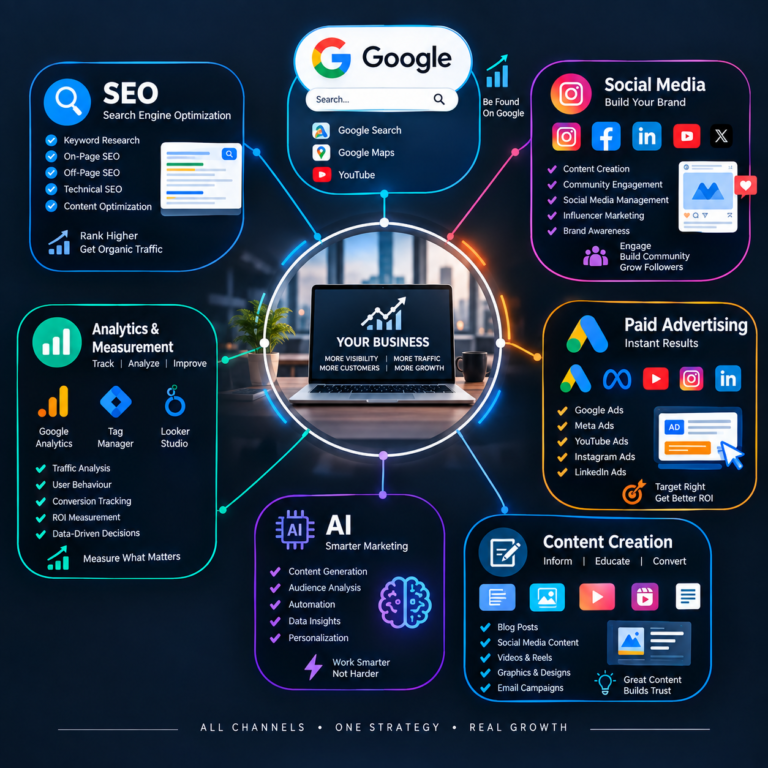
In simple words, digital marketing is the process of promoting products, services, or brands through digital channels such as search engines, websites, social media, email, and online advertising.
For students and beginners, understanding digital marketing is the first step toward exploring a wide range of career opportunities.
What Is Digital Marketing?
Digital marketing means promoting a business, product, service, or brand using digital channels and technologies.
Unlike traditional marketing, digital marketing uses platforms such as:
- Search engines
- Websites
- Social media
- Online advertising platforms
- Video platforms
- Mobile applications
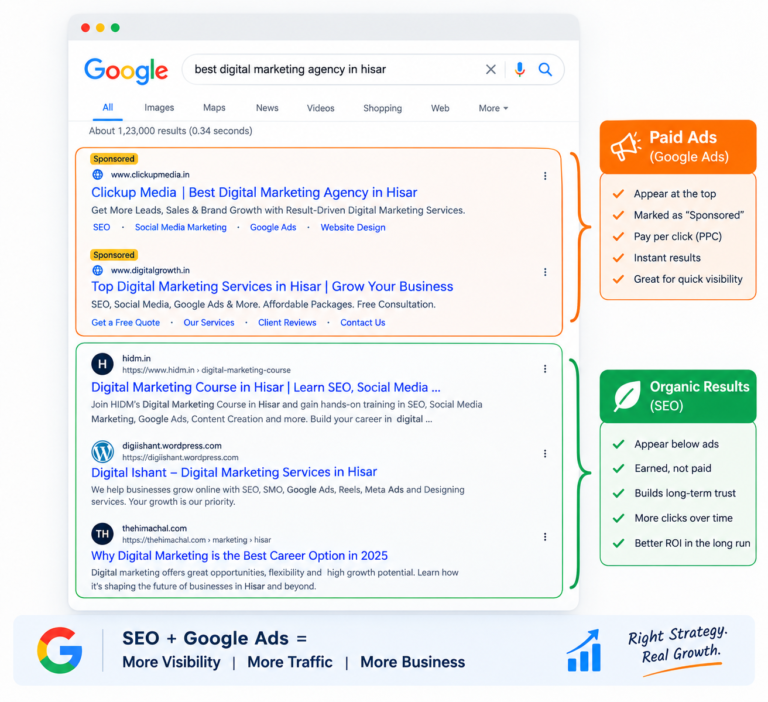
For example, suppose you search Google for “digital marketing course.” You may see organic search results as well as paid advertisements. Businesses use SEO and Google Ads to reach people through these search results.
Similarly, when you see a sponsored Instagram post or a brand’s Reel, that is another example of digital marketing.
Therefore, digital marketing combines different online strategies to connect businesses with their target audiences.
In simple terms:
Digital Marketing = Reaching the right people through the right digital channels at the right time.
Why Is Digital Marketing Important?
The way people discover businesses has changed significantly.
Today, customers often search online before making a purchase. They may compare products, read reviews, watch videos, visit websites, and check social media profiles.
Because of this behaviour, businesses need to be visible where their potential customers spend time.
Digital marketing can help businesses:
- Increase online visibility
- Build brand awareness
- Reach specific audiences
- Generate leads
- Increase website traffic
- Communicate with customers
- Measure campaign performance
- Improve marketing strategies
Moreover, digital marketing provides access to useful performance data.
For instance, marketers can analyse clicks, impressions, engagement, leads, conversions, and other metrics. As a result, businesses can make more informed marketing decisions.
What Are the Types of Digital Marketing?
Digital marketing includes several different areas. Each one has a specific purpose and can support different business goals.
Let’s look at the major types of digital marketing.
1. Search Engine Optimization (SEO)
Search Engine Optimization (SEO) is the process of improving a website and its content so that search engines can understand and discover it more effectively.
For example, imagine that someone searches for “digital marketing course in India.” An institute may use SEO to improve its chances of appearing in relevant organic search results.
SEO includes areas such as:
- Keyword research
- On-page SEO
- Technical SEO
- Off-page SEO
- Local SEO
- Content optimization
However, SEO is generally a long-term strategy. Therefore, businesses need to focus on creating useful content and improving their websites consistently.
2. Google Ads and Paid Advertising
SEO is not the only way to appear on search engines.
Businesses can also use paid advertising platforms such as Google Ads to reach potential customers.
For example, a business can create advertisements for users searching for specific products or services.
Paid advertising can help businesses:
- Generate targeted traffic
- Reach specific audiences
- Generate leads
- Promote products and services
- Measure campaign performance
However, successful advertising requires proper targeting, compelling ad copy, relevant landing pages, and continuous optimization.
3. Social Media Marketing
Social media marketing involves using platforms such as Instagram, Facebook, LinkedIn, YouTube, and other social networks to connect with an audience.
Businesses use social media to:
- Build brand awareness
- Share useful content
- Promote products
- Engage with customers
- Generate leads
- Build online communities
However, social media marketing is not simply about posting every day.
A good strategy considers the target audience, content format, platform, messaging, engagement, and business goals.
For example, a B2B company may focus more on LinkedIn, while a lifestyle brand may use Instagram and YouTube more actively.
4. Content Marketing
Content marketing focuses on creating and sharing valuable content for a specific audience.
Common examples include:
- Blog posts
- Videos
- Reels
- Infographics
- Guides
- Case studies
- E-books
- Social media posts
For example, instead of directly promoting a digital marketing course in every post, an institute can publish an educational blog about SEO, Google Ads, or digital marketing careers.
As a result, useful content can help a brand attract people who are actively looking for information.
5. Email Marketing
Email marketing involves communicating with customers and potential customers through email.
Businesses may use email marketing for:
- Newsletters
- Offers
- Product updates
- Educational content
- Lead nurturing
- Customer communication
Furthermore, email marketing can help businesses maintain relationships with their existing audience.
6. Influencer Marketing
Influencer marketing involves collaborating with creators who have an established audience.
A business can partner with a relevant creator to introduce its product or service to potential customers.
However, audience relevance is important. A creator should ideally have an audience that matches the business’s target market.
How Does Digital Marketing Work?
Now that we understand the different types, let’s look at how digital marketing works.
A digital marketing campaign usually starts with a clear objective.
For example, a business may want to:
Build awareness → Increase website traffic → Generate leads → Convert customers → Build long-term relationships
To achieve these goals, marketers first understand the target audience.
Next, they select suitable digital channels. After that, they create content, advertisements, or campaigns.
Finally, they measure the results and improve the strategy.
A simple digital marketing process looks like this:
Research → Strategy → Content/Campaign → Distribution → Measurement → Optimization
Importantly, digital marketing does not stop after publishing a post or launching an advertisement.
Marketers need to analyse the results. If a campaign does not perform as expected, they can test different audiences, content, advertisements, landing pages, or strategies.
Therefore, testing and optimization are important parts of digital marketing.
The Role of AI in Digital Marketing
Artificial Intelligence has become an important part of modern digital marketing.
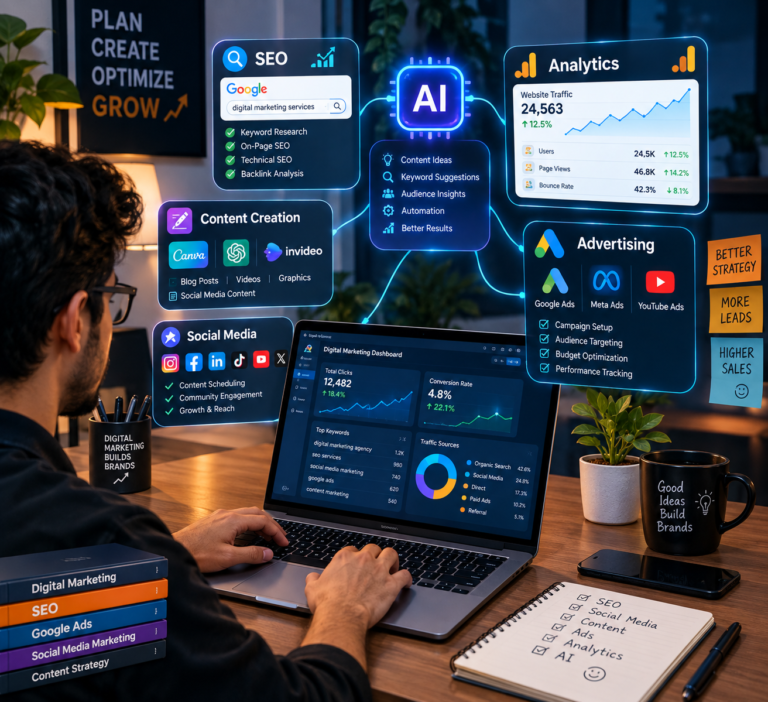
Today, AI tools can assist marketers with several tasks, including:
- Content ideation
- Research
- Data analysis
- Creative concepts
- Audience insights
- Personalization
- Marketing automation
- Workflow optimization
For example, a marketer can use AI to generate content ideas, analyse campaign data, or create initial drafts.
However, AI should not replace human thinking.
Marketers still need to understand customers, evaluate information, check accuracy, develop strategies, and make final decisions.
Therefore, learning AI and digital marketing together can help students understand how modern marketing workflows are evolving.
What Skills Do You Need to Learn Digital Marketing?
One of the biggest advantages of digital marketing is that beginners can develop their skills step by step.
Some important digital marketing skills include:
- SEO
- Keyword research
- Content marketing
- Social media marketing
- Google Ads
- Meta Ads
- Analytics
- Copywriting
- Basic graphic design
- AI tools
- Communication
- Marketing strategy
In addition, analytical thinking is useful because marketers often work with performance data.
Creativity is also important. After all, brands need engaging ideas to attract and retain attention.
Most importantly, practical experience can help beginners understand how different concepts work in real situations.
Is Digital Marketing a Good Career Option?
Digital marketing offers multiple career paths because businesses need professionals with different digital skills.
Depending on their interests, beginners can explore roles such as:
- Digital Marketing Executive
- SEO Executive
- SEO Specialist
- Social Media Executive
- Social Media Manager
- Google Ads Specialist
- Performance Marketer
- Content Marketer
- Email Marketing Specialist
- Digital Marketing Manager
- Freelancer
- Digital Marketing Consultant
For example, someone who enjoys writing may explore content marketing. Similarly, someone who enjoys data and advertising may explore performance marketing.
Therefore, beginners do not always need to choose a specialization immediately. Learning the fundamentals first can help them understand which area interests them most.
How Can Beginners Start Learning Digital Marketing?
If you are completely new to digital marketing, you may feel confused because there are many platforms and tools to learn.
Fortunately, you can follow a simple step-by-step approach.
Step 1: Learn the Fundamentals
Start by understanding basic marketing concepts, customer behaviour, digital channels, and marketing funnels.
Step 2: Learn SEO
Understand keyword research, on-page SEO, technical SEO, content optimization, and local SEO.
Step 3: Explore Social Media Marketing
Learn how businesses use social platforms to build awareness, engagement, and communities.
Step 4: Learn Paid Advertising
Understand the basics of Google Ads, Meta Ads, targeting, campaign structures, and performance metrics.
Step 5: Learn Analytics
Understand how marketers measure traffic, engagement, leads, conversions, and campaign performance.
Step 6: Explore AI Tools
Learn how AI can support content creation, research, analysis, automation, and marketing workflows.
Step 7: Practise With Projects
Finally, apply your knowledge through practical projects.
This is important because digital marketing is a practical field. Understanding theory is useful; however, applying that knowledge helps develop real skills.
Why Practical Learning Matters in Digital Marketing
Digital marketing continues to evolve.
Search engines change, social media platforms introduce new features, advertising systems develop, and AI tools continue to improve.
Therefore, marketers need to keep learning.
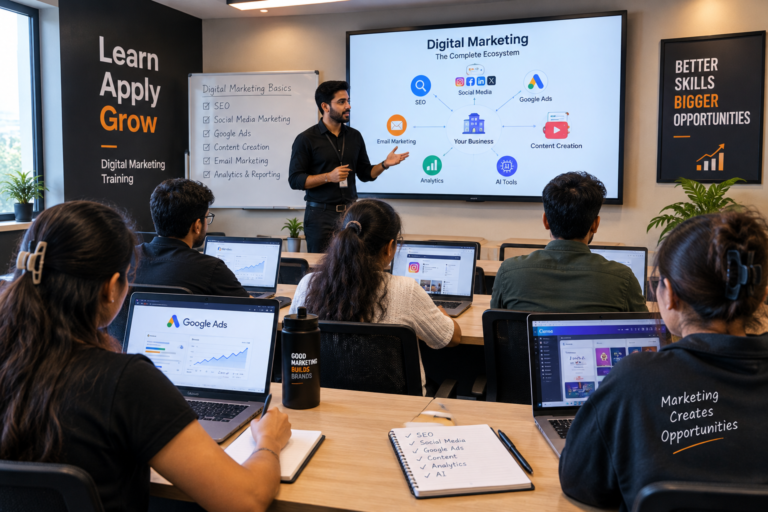
Practical training can help students understand how marketing works beyond textbooks.
For example, students can practise:
- Creating SEO strategies
- Conducting keyword research
- Developing social media content
- Building advertising campaigns
- Analysing marketing data
- Using AI tools
- Creating marketing reports
As a result, practical learning can help beginners become more comfortable with real-world marketing tasks
Why Learn AI-Integrated Digital Marketing?
Digital marketing and AI are increasingly connected.
An AI-integrated approach combines traditional digital marketing fundamentals with modern AI tools and workflows.
For example, marketers can explore how AI can support:
- Content ideas
- SEO research
- Social media planning
- Ad creative development
- Customer research
- Data analysis
- Marketing automation
However, the goal should not be to depend entirely on AI.
Instead, marketers should learn how to use AI as a productivity and decision-support tool while keeping human creativity, strategy, and quality control at the centre.
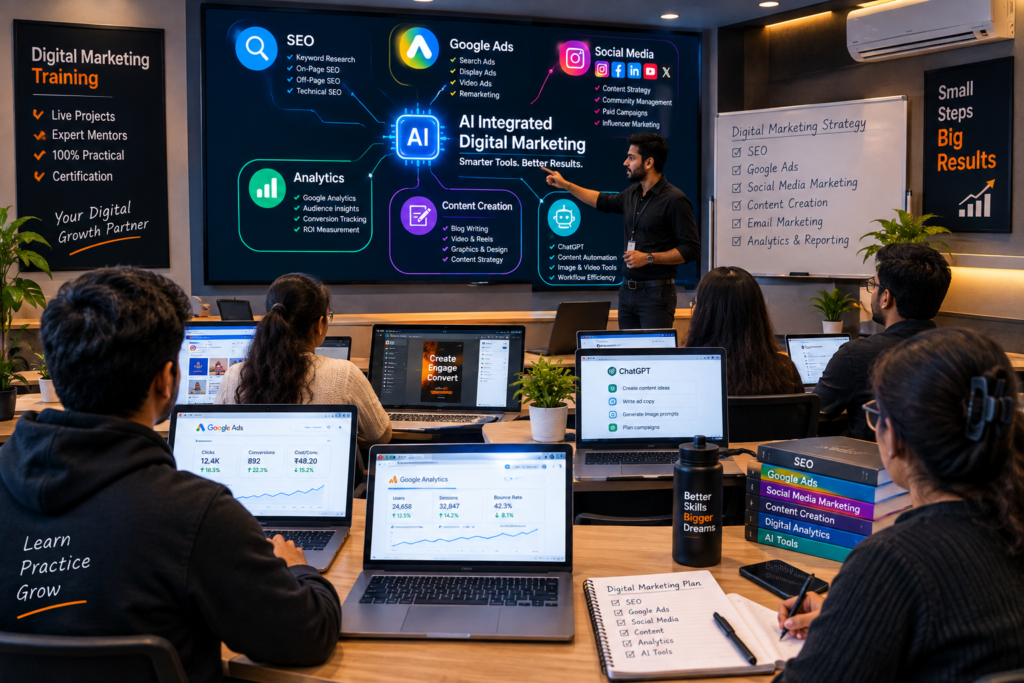
Digital Marketing Is More Than Social Media
Many beginners think digital marketing simply means posting on Instagram or Facebook.
However, social media is only one part of digital marketing.
A complete digital marketing strategy may combine:
SEO + Content Marketing + Social Media + Google Ads + Meta Ads + Email Marketing + Analytics + AI
Different businesses may use different combinations.
For instance, a local business may focus heavily on Local SEO and Google Business Profile. On the other hand, an e-commerce business may use SEO, paid advertising, social media, email marketing, and conversion optimization.
Therefore, digital marketing should be viewed as a complete ecosystem rather than a single platform.
Frequently Asked Questions About Digital Marketing
What is digital marketing in simple words?
Digital marketing means promoting a business, product, service, or brand through digital channels such as search engines, websites, social media, email, and online advertising.
Is digital marketing suitable for beginners?
Yes. Beginners can start with the fundamentals and gradually learn SEO, social media marketing, content marketing, Google Ads, Meta Ads, analytics, and AI tools.
Do I need coding skills to learn digital marketing?
No. Coding is not a basic requirement for starting digital marketing. However, some technical knowledge can be useful for advanced SEO and website-related work.
How long does it take to learn digital marketing?
The learning time depends on your goals, learning method, and level of expertise. Beginners can learn the fundamentals within a structured period, while developing strong practical skills requires continuous practice.
How is AI used in digital marketing?
AI can assist with research, content ideas, data analysis, creative development, personalization, automation, and other marketing workflows. Human strategy and review remain important.
What are the main types of digital marketing?
The major types include SEO, paid advertising, social media marketing, content marketing, email marketing, influencer marketing, and other digital strategies.
Start Your Digital Marketing Journey With HIDM
Digital marketing combines creativity, technology, communication, analytics, and strategy.
For students, graduates, and beginners, learning these skills can open the door to different career paths, including SEO, social media, paid advertising, content marketing, performance marketing, and freelancing.
At HIDM, the learning approach focuses on connecting digital marketing fundamentals with modern AI tools and practical applications.
Whether you want to learn SEO, Google Ads, Meta Ads, social media marketing, content marketing, or AI-powered marketing, building strong fundamentals is an important first step.
Final Takeaway
So, what is digital marketing?
In simple terms, digital marketing is the use of digital channels, platforms, technology, and marketing strategies to connect businesses with their audiences.
However, it is much more than running advertisements or posting on social media.
It involves understanding people, creating useful content, reaching the right audience, measuring results, and continuously improving marketing strategies.
Moreover, as AI becomes increasingly integrated into digital workflows, modern marketers need to understand both marketing fundamentals and technology.
If you are starting your journey today, focus on learning the basics, practising consistently, exploring AI tools, and keeping up with changes in the digital industry.
Start learning. Keep practising. Build your digital marketing skills.