
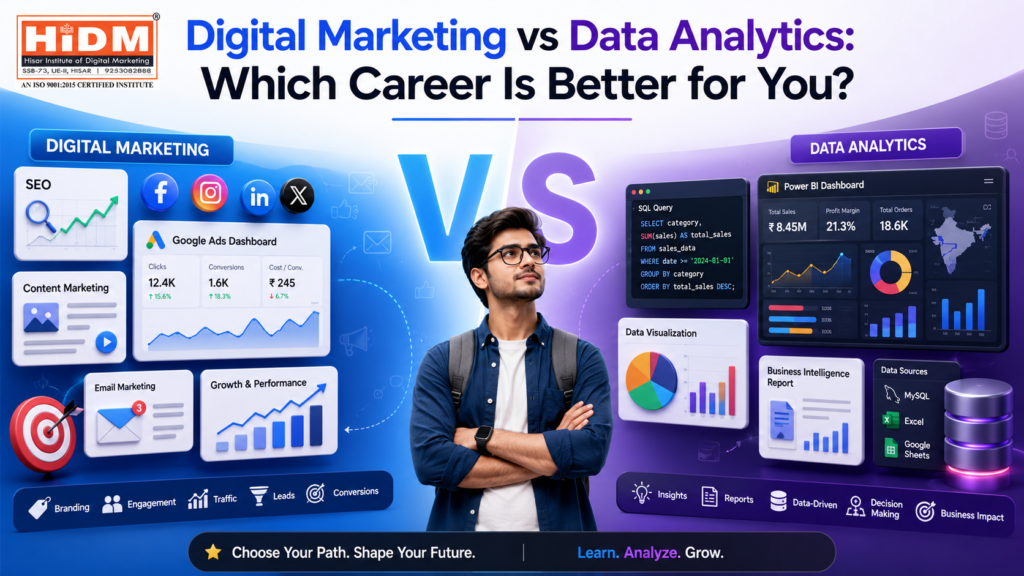
In today’s digital economy, two career fields are attracting significant attention from students and professionals alike: digital marketing and data analytics. Both industries offer excellent growth opportunities, competitive salaries, and increasing demand across various sectors.
However, many students find themselves confused when choosing between these two career paths. They often wonder which field offers better job opportunities, easier entry, faster growth, and long-term career stability.
The truth is that both careers have strong potential, but they require different skill sets, interests, and career goals. Understanding the differences can help students make an informed decision.
At Hisar Institute of Digital Marketing (HIDM), students frequently ask whether they should pursue Digital Marketing or Data Analytics. The answer depends on individual strengths, interests, and career aspirations.
Let’s compare both career options in detail.
Understanding Digital Marketing

Digital Marketing involves promoting products, services, or brands through online channels such as search engines, social media platforms, websites, email campaigns, and paid advertisements.
The primary goal of a digital marketer is to attract potential customers, generate leads, increase sales, and improve brand visibility.
A digital marketing professional may work on:
- Search Engine Optimization (SEO)
- Google Ads
- Meta Ads
- Social Media Marketing
- Content Marketing
- Email Marketing
- Lead Generation
- Website Optimization
- Performance Marketing
Digital marketers combine creativity with analytical thinking to achieve business objectives.
Understanding Data Analytics
Data Analytics focuses on collecting, organizing, analyzing, and interpreting data to support business decisions.
Data analysts work with large amounts of information to identify trends, patterns, and insights that help companies improve performance.
A data analyst may work on:
- Data Cleaning
- Statistical Analysis
- Dashboard Creation
- Data Visualization
- Business Intelligence
- Predictive Analysis
- Reporting
- Performance Measurement
Their role is to transform raw data into actionable business insights.
Key Difference Between Digital Marketing and Data Analytics
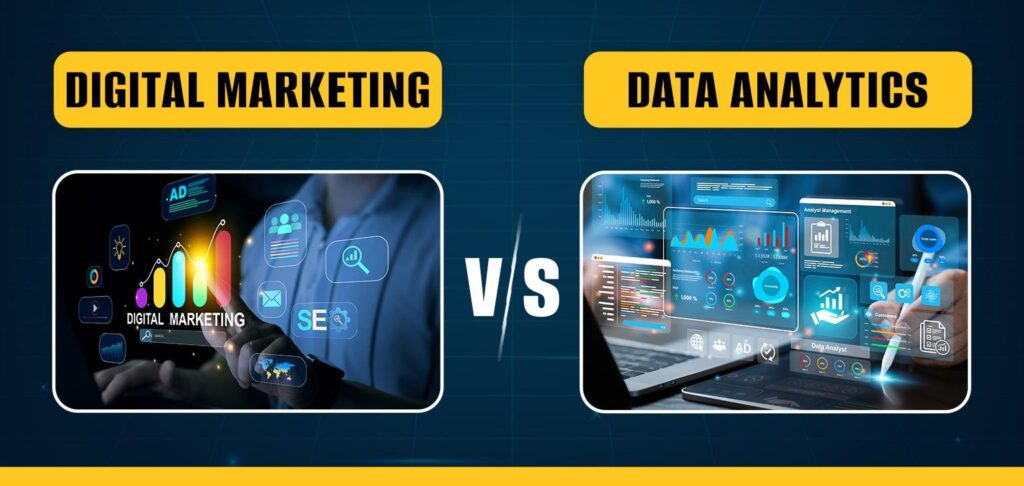
The biggest difference lies in their primary objectives.
Digital marketers focus on driving business growth through online marketing activities.
Data analysts focus on understanding data and providing insights that help businesses make better decisions.
While digital marketers create campaigns and attract customers, data analysts measure performance and identify trends.
Interestingly, both fields often work together. Digital marketers use analytics data to optimize campaigns, while data analysts help organizations understand customer behavior and marketing performance.
Skills Required for Digital Marketing
Digital marketing requires a combination of technical and creative skills.
Some important skills include:
- SEO
- Content Writing
- Social Media Management
- Advertising Campaign Management
- Communication Skills
- Keyword Research
- Marketing Strategy
- Basic Data Analysis
- Creativity
Students who enjoy marketing, communication, branding, and creativity often find digital marketing more engaging.
At HIDM, students receive practical exposure to these skills through live projects and hands-on training.
Skills Required for Data Analytics
Data analytics is generally more technical and data-driven.
Important skills include:
- Microsoft Excel
- SQL
- Power BI
- Tableau
- Statistics
- Python
- Data Visualization
- Critical Thinking
- Data Interpretation
Individuals who enjoy working with numbers, logic, and problem-solving often prefer data analytics.
Learning Curve Comparison

One of the major considerations for students is how difficult each field is to learn.
Digital marketing generally has a lower entry barrier. Beginners can start learning practical skills relatively quickly and begin working on projects within a few months.
Data analytics typically requires a stronger understanding of data, statistics, and analytical tools. The learning curve may be steeper, especially for students without a technical background.
This is one reason why many students choose digital marketing as their first career option.
Job Opportunities
Both industries currently offer strong employment opportunities.
Digital marketing roles include:
- SEO Executive
- Social Media Manager
- Google Ads Specialist
- Content Marketer
- Performance Marketer
- Digital Marketing Executive
Data analytics roles include:
- Data Analyst
- Business Analyst
- Reporting Analyst
- Business Intelligence Analyst
- Data Visualization Specialist
As businesses increasingly rely on digital channels and data-driven decision-making, demand for professionals in both fields continues to grow.
Salary Potential
Salary depends on skills, experience, and location.
Entry-level professionals in both fields can earn competitive salaries, while experienced specialists often command significantly higher compensation.
Data analytics positions sometimes offer slightly higher starting salaries due to the technical expertise required.
However, experienced digital marketers working in performance marketing, SEO consulting, or digital marketing management can also achieve excellent earning potential.
Freelancing and entrepreneurship opportunities are generally more accessible in digital marketing.
Freelancing and Business Opportunities

Digital marketing offers numerous freelancing opportunities.
Professionals can provide services such as:
- SEO
- Social Media Management
- Google Ads
- Content Marketing
- Lead Generation
Many digital marketers eventually start their own agencies or consulting businesses.
While freelance opportunities exist in data analytics as well, they are generally less common and often involve specialized projects.
Students interested in building their own business often find digital marketing particularly attractive.
Which Career Has More Creativity?
Digital marketing involves a significant amount of creativity.
Professionals regularly create content strategies, advertising campaigns, social media content, and marketing ideas.
Data analytics, on the other hand, focuses more on numbers, reports, and logical problem-solving.
If you enjoy creative thinking and communication, digital marketing may be a better fit.
If you enjoy working with data and uncovering insights, data analytics may be the ideal choice.
Why Many Students Choose Digital Marketing First
Many students begin with digital marketing because it offers:
- Faster skill development
- Lower technical barriers
- Freelancing opportunities
- Entrepreneurial potential
- Diverse career options
- Practical project-based learning
At Hisar Institute of Digital Marketing (HIDM), students gain practical experience through live projects, campaign management, SEO activities, and performance marketing training. This hands-on approach helps learners build industry-ready skills and understand how businesses generate results online.
Conclusion
Both Digital Marketing and Data Analytics are promising career options with strong future demand.
Digital Marketing is ideal for individuals who enjoy creativity, communication, branding, and business growth strategies.
Data Analytics is well-suited for individuals who enjoy numbers, statistics, data interpretation, and problem-solving.
The best career choice depends on your interests, strengths, and long-term goals.
For students seeking a practical, versatile, and rapidly growing career path with opportunities in freelancing, agency work, startups, and corporate organizations, Digital Marketing continues to be one of the most accessible and rewarding career options. Through industry-focused training at Hisar Institute of Digital Marketing (HIDM), students can build the practical skills required to succeed in today’s competitive digital economy.